
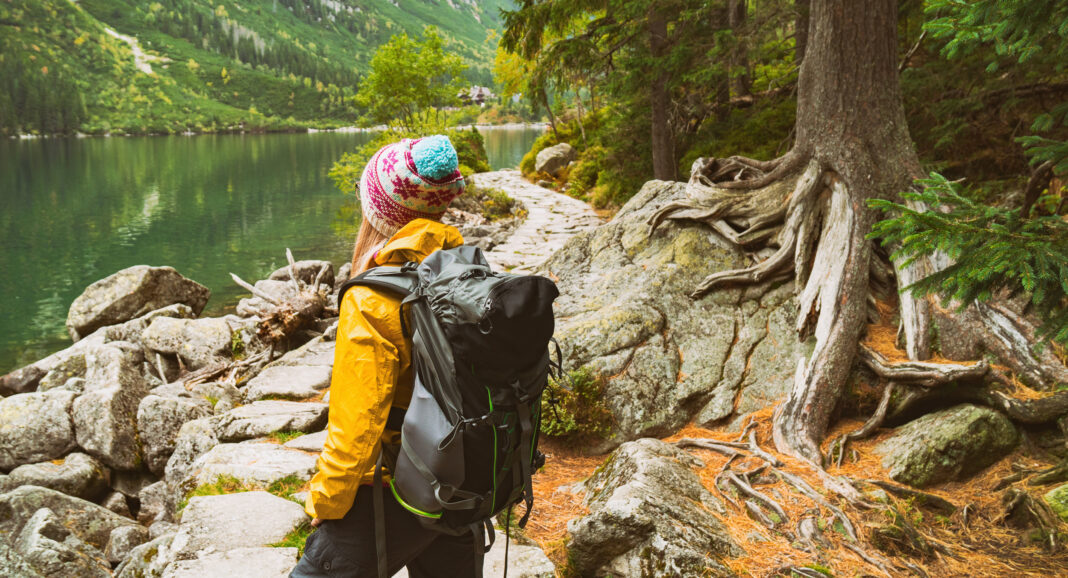
If Henry David Thoreau were alive today, he would probably tell you to get off your cell phone or computer and take a hike in a park or, better yet, take a longer trek into nature. Recent advances in the emerging field of environmental neuroscience are supporting Thoreau’s admonishing.
Over the past few decades, researchers have accumulated evidence showing that spending time in nature benefits mental health, physical health, stress physiology, and cognitive functioning.
This may seem intuitive. As our world becomes more and more urbanized, people spend an increasing amount of time indoors. For many of us, getting outside and into nature is the “mental reboot” we need to recalibrate our senses and reconnect with our evolutionary roots. We often return from an outing feeling more focused and less stressed. But why?
Research suggests that being in nature changes the way we attend to the world around us. In our everyday urban environments, we are constantly bombarded with stimuli competing for our limited attention—email notifications, text messages, television and persistent social media chatter. Over time, this constant stimulation depletes our neural reserves. When we are in nature and off our technology, we give the brain a chance to rest and recuperate from these relentless attentional demands.
Researchers at Colorado State University and the University of Utah are studying how this cognitive restoration may be reflected in our brain activity. Their research explores how attentional processes in the brain change in nature compared to urban environments.
Because urban environments place greater demand on our attentional networks than natural environments, the team hypothesizes that spending time in nature alters attention-related brain activity.
To test this, Dr. Amy McDonnell and Dr. David Strayer take research participants into the Southern Utah wilderness for multiple days at a time and record brain activity using a method called electroencephalography (EEG).
EEG measures the brain’s electrical activity through sensors placed on the scalp, allowing the researchers to track moment-to-moment changes in brain functioning as participants are immersed in nature.
EEG is non-invasive and can provide a more objective measure of an individual’s experience in nature than self-report questionnaires. While self-reports are valuable, they can be influenced by an individual’s expectations or unintended pressure to provide socially desirable answers. By measuring brain activity directly, researchers can examine how the brain responds to nature in real time and identify the neural mechanisms that may underlie improvements in attention.
McDonnell and Strayer’s findings have largely supported their predictions. After four days of immersion in nature, research participants show changes in brain activity associated with working memory, visual engagement, error processing, and reward processing—all important aspects of attention and cognitive functioning. This work has helped researchers move beyond simply asking whether nature is beneficial and toward understanding exactly how exposure to nature changes the way the brain functions.
McDonnell and Strayer are also curious whether people need to spend several days in the wilderness to experience these benefits or whether a shorter exposure to nature can produce similar effects.
To answer this question, they have tested whether a short walk in a local arboretum replicates the attentional benefits they had observed following a multiday immersion in nature.
In one such study, 92 participants were randomly assigned to take a 40-minute walk either through Salt Lake City’s Red Butte Garden or on a nearby urban medical campus. The results mirrored those from the wilderness studies.
The urban walk placed greater demands on the brain’s attention networks, while the walk in nature appeared to give those networks an opportunity to rest and recover. As a result, participants who had walked in nature performed better on a subsequent cognitive task.
These findings suggest that you may not need to disappear into the wilderness for multiple days to experience nature’s benefits, but even a brief walk through a natural environment can help restore attention and improve cognitive functioning.
Researchers in this growing field of environmental neuroscience are working to understand what it is, specifically, about nature that has such a positive impact on mental, physical, and cognitive health.
Is it the exercise that is often associated with being outside?
Is it the opportunity to disconnect from our devices and escape the constant stream of notifications competing for our attention?
Is it the socializing we do around a campfire and on a hike with friends?
Or is it a combination of these elements that creates a more restorative environment and gives the brain an opportunity to rest and recuperate?
The answers are still emerging. As researchers continue to investigate the mechanisms underlying nature’s benefits, they draw inspiration from both modern science and the observations of naturalists, philosophers, and indigenous communities who recognized the value of nature long before brain imaging existed.
In many ways, contemporary environmental neuroscience is beginning to provide empirical support for insights that thinkers like Thoreau articulated more than a century ago.
You may also like: Dopamine & Your Brain

Read This Story in Our 2026 Summer & Outdoor Issue
Canada’s best source of health & fitness information — IMPACT Magazine’s 2026 Summer Outdoor Travel Issue: trail running, outdoor travel, workouts and seasonal recipes.
Featuring world-class French-Canadian ultra-trail runner Mathieu Blanchard, this digital edition takes you coast to coast through Canada’s most unforgettable bucket-list hikes, trail-running tips, and race-day strategies. Build strength and balance with targeted summer workouts, master the taper, and find your footing on technical terrain. Plus enjoy seasonal grilling and plant-forward recipes — Grilled Mexican Corn, Hoisin Portobello Burgers with Chili Lemon Broccolini, Smoky Black Bean Quinoa Burgers — and more outdoor cooking inspiration for active travelers.