

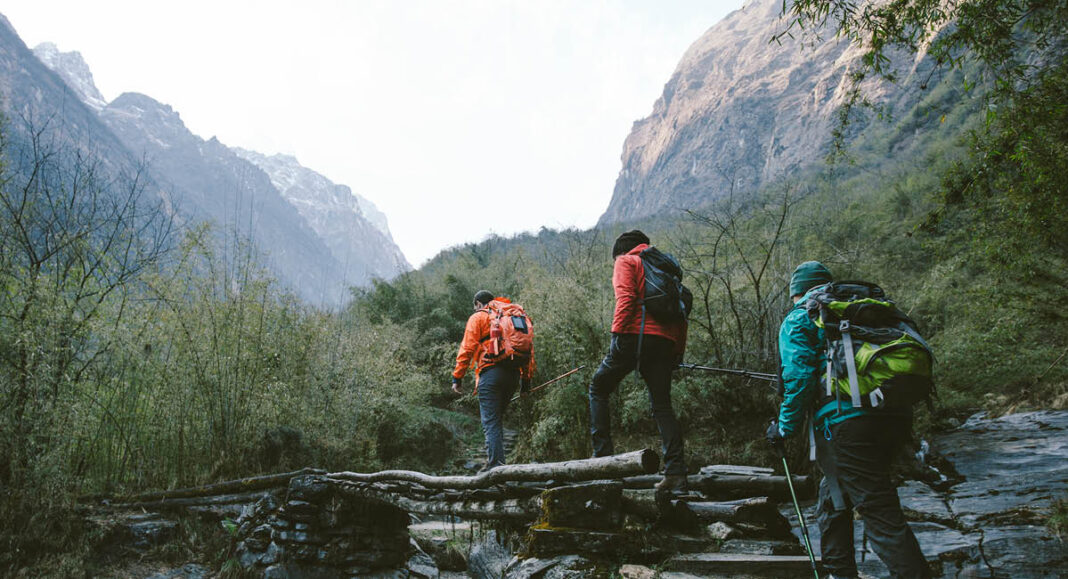
The outdoors doesn’t care what gear you have, how strong your legs are, or if your body moves in traditional ways. What it does care about (if it had a soul and a voice) is that you show up. It wants you to feel. To breathe. To step out of your looping thoughts and into the dirt, the wind, the birdsong.
I’ve walked, wheeled, camped, cried, cooked on the fire, sprinted trails, sat in canoes, looked for bears in bear country
and stretched under skies so wide they reminded me how small my worries really were. In every province and territory. The space is there to stop and just BE. The outdoors is the ultimate therapist.
Mental Health in Motion
Whether you’re hiking with your golden retriever or wheeling along a riverside trail, movement outdoors gives your brain something extraordinary—it provides a presence. It’s hard to return emails when your feet are navigating tree roots or your arms are propelling you up a gravel path.
In Canada, where the seasons shape our routines, mental health in motion has its own rhythm. We hibernate and we bloom. We struggle through slush and then—bam!—we’re outside in tank tops, arms up to the sky like sunflowers.
For outdoor enthusiasts—able-bodied or mobility-limited—there’s no single way to “do” the outdoors. What matters is that
we move. On our terms. With intention. In nature.
It’s really that simple.
The Yin and Yang of the Outdoor Soul
Ever notice how some people need the forest to calm their nerves and others need a windswept peak to wake up? That’s yin and yang in action.
Yin is the still lake, the hammock, the restorative hike, the moonlight.
Yang is the sweat, the summit, the sprint, the sunlight.
Your outdoor life doesn’t have to be one or the other. Some days, you need to walk slowly and listen to birds. Other days, you need to run until your lungs burn and your thoughts finally shut up. Both are valid. Both are sacred. Your nervous system thanks you for doing either.
8 Ways to Make Time for Mental Health in Motion
- Block one “green hour” weekly: If it’s not scheduled, it’s toast. Try this: Choose a consistent time (e.g., Sundays 10 – 11 a.m.). Label it “Green Hour” in your calendar. Commit to moving, reflecting, or just being outside.
- Pair screen life with green life: Take your weekly calls outdoors. Try pacing, strolling, or wheeling during voice notes or catch-ups. Move while you Zoom (with audio only!). Trade 10 minutes of scrolling for 10 minutes of fresh air. Even micro-movements outside recalibrate your nervous system.
- Start or end with the sky: Let the sky set your nervous system. Set an alarm for sunrise or sunset twice a week. Stretch outdoors with five poses or breath cycles. Add a mantra: “I rise like the sun” or “I settle like the moon.”
- Gear up for good: Comfort invites consistency. Budget for one piece of good gear this season.
- Journal with trees: Nature rewrites your stress response. Bring a notebook outside. Use prompts: “What does the wind remind me of?” or “What am I holding onto that’s not mine?” End entries with: “And still, I’m here.” If you can’t write, use a voice memo app.
- Micro adventures, macro gains: Adventure doesn’t mean distance—it means depth. Make a list of three trails, parks, or green zones within 15 minutes of you.
- Share the outside: We’re wired for connection. Pick a weekly “outside accountability buddy.” Try a Sunday walk, outdoor stretch date, or fireside reflection session. Encourage friends to match your pace, not the other way around. Equal energy, not equal stride.
- Don’t wait for perfect weather: Create an outside rescue kit: coat, shoes, thermos, blanket, mobility aid. Post a mantra near your door: “Outdoors first. Feelings will follow.” Our ancestors didn’t wait for perfect weather. Neither should we.
And as a final thought—never forget that Canada still waits for you—your path and your heartbeat. Whether you’re pushing wheels over gravel, tying your boots, or tucking into a thermos of soup by a quiet creek, you, my friend, are healing.
This isn’t about peak performance. It’s about present connection—with your breath, your body, and this wild, beautiful place we call home.
Mental health in motion is a simple and profound Canadian courage. And it starts with a single step or wheeling outside.
Facts About the Canadian Outdoors:
- Canada has 38 national parks and over 1,000 provincial parks—and many are wheelchair-accessible.
- The Trans Canada Trail is the longest recreational trail in the world—over 28,000 km.
- Nearly 90 per cent of Canadians live within 10 minutes of a park or green space.
- Forest bathing is a recognized mental health practice in several Canadian provinces.
- In First Nations culture, the land is considered a spiritual teacher—not just terrain.
- Canada is home to more freshwater lakes than the rest of the world combined.
- Many provincial parks offer adaptive equipment rentals—like all-terrain wheelchairs and accessible kayaks.
- Spending just 20 minutes in nature can reduce cortisol levels significantly.
You may also like: Best Outdoor Adventure Apparel

Read This Story in Our 2025 Summer Outdoor Travel Issue
IMPACT Magazine Summer Outdoor Travel Issue 2025 featuring Shanda Hill, a Canadian Ultra Triathlete who is redefining the sport. Run on some epic trails in our own backyard or join a run club. Eat your way for Mental Clarity, fueling while travelling, seasonal eating and some kitchen must haves. Become strong and fit in only 20 minutes a day, and enjoy some tasty drinks guilt free and so much more.