
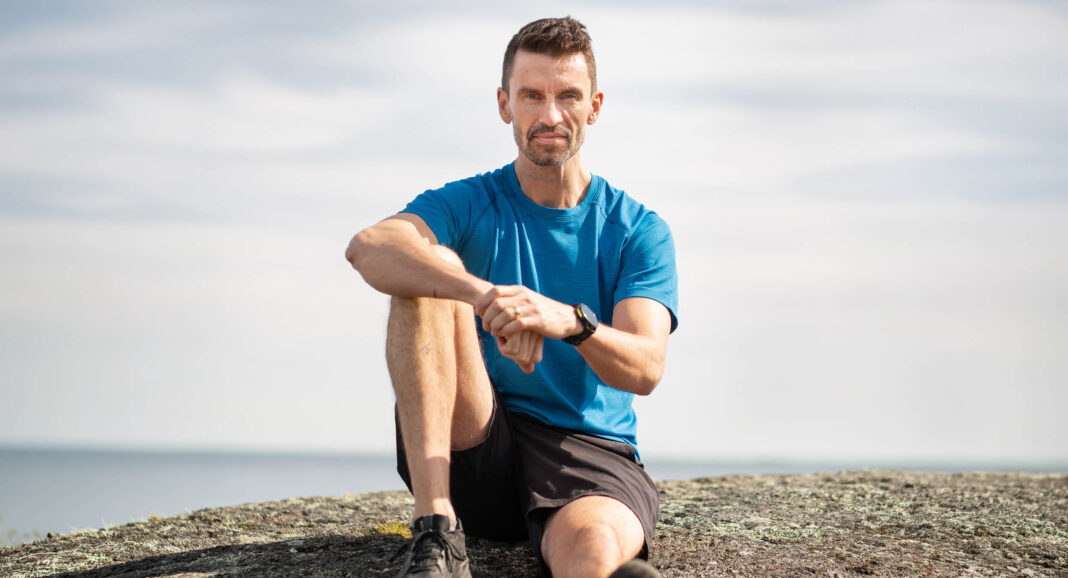
Crossing the finish line in front of the historic B.C. parliament building in Victoria, Mike Shaw was flooded with gratitude.
He’d just run the half-marathon at the 2025 Royal Victoria Marathon in 2 hours, 12 minutes, and he was elated, not just for completing the race, but for every step he takes.
“I know how lucky I am,” the recent Victoria transplant says. “Anytime I finish a race, it’s a win.”
In 2013 at age 26, Shaw suffered a catastrophic ski injury. He was in Colorado coaching a group of half pipe Olympic hopefuls and was demonstrating a trick he had completed countless times, a Nose Butter 720, with two revolutions in the air. But on this December afternoon, he landed in punchy snow. His feet stopped dead while his upper body pitched forward, slamming his head into the ground and dislocating his neck.
Hours later at a hospital in Denver, the surgeon recommended fusing vertebrae C3 to C7. While the doctor didn’t expect Shaw to walk again, he said there was a chance he might regain some movement in his arms. Shaw said yes to the surgery, and when he woke found he had some function in his biceps.
With rest and rehabilitation, more function returned. Within six months, he walked the 5-kilometre race at the Scotiabank Vancouver Half-Marathon. On the one-year anniversary of his injury, he skied in Whistler, wearing the same skis he crashed in. Eleven years after the accident, he ran his first marathon.
An incomplete quadriplegic, Shaw can’t fully feel his legs or hands and can’t feel the ground beneath his feet.
As victories accumulated, Shaw became a public speaker to share the story of his remarkable recovery and the role of gratitude in his journey. He’s been a TEDx speaker and subject of a Red Bull documentary, and he released a book called Never Part of the Plan.
“I’m aware that not everybody gets better from a spinal cord injury,” he reflects. “I got super lucky.”
The challenges of his spinal cord injury linger, however. An incomplete quadriplegic, Shaw can’t fully feel his legs or hands and can’t feel the ground beneath his feet. He struggles with his balance, losing it up to 50 times a day. He doesn’t have the full sense of touch, so relies heavily on his vision to perceive where he is in space. His muscles get spastic when he fatigues.
Yet, where difficulties persist, so too does gratitude. To demonstrate his thankfulness, Shaw frequently runs for a purpose. At the Victoria marathon, he championed the Children’s Health Foundation of Vancouver Island, a non-profit that supports the health care journeys of children and youth. One of the foundation’s core programs is operating the accommodation near hospitals where families can stay when a child needs care. Shaw is a new father to a one-year-old boy and helping families facing the unthinkable hits close to home. He recalls vividly the financial toll and stress his parents were under when he was hospitalized for months, first in Denver, then in Vancouver.
Supporting causes is what led him to running in the first place. Once his recovery was on track, he set a goal to participate in the Wings for Life World Run, which raises awareness and funds for those with spinal cord injuries. The run takes place in May on the same date and time around the world. There’s no set distance; participants run as far as they can.
“It’s all about running for those who can’t,” explains Shaw, noting the 2025 race had more than 310,000 runners from 170 countries.
After the Wings for Life run this May, Shaw will begin training for the Royal Victoria Marathon in October, with the goal of raising $10,000 for the Children’s Health Foundation. His legs don’t always cooperate—he has to tell them almost every step to keep going—but he doesn’t take his ability to run for granted: “I lean into gratitude and how lucky I am to have the body and the health that I do. It gives me that fire to get up and get moving.”
His focus on gratitude has prompted a career change. In 2024, he completed a Master of Arts in Counselling Psychology and subsequently launched a counselling practice called Gratus Health.
“I got into mental health because I realized I had an opportunity based on my lived experience to really support people going through adversity and difficulty,” he explains, adding that his new profession feels like a calling rather than a career.
Gratitude is the foundation of his practice—the Latin root of the word is in the name—and he’ll draw on his experience as a professional athlete and coach to guide his clients, focusing on body and mind.
“The mindset tools that elite athletes use aren’t reserved for elite athletes,” he says. “I implore people to push their personal limits and do things outside of their comfort zone from a place of appreciation and gratitude for what your body can do.”
Photography: Brynn Featherstone
You may also like: Athletes with IMPACT
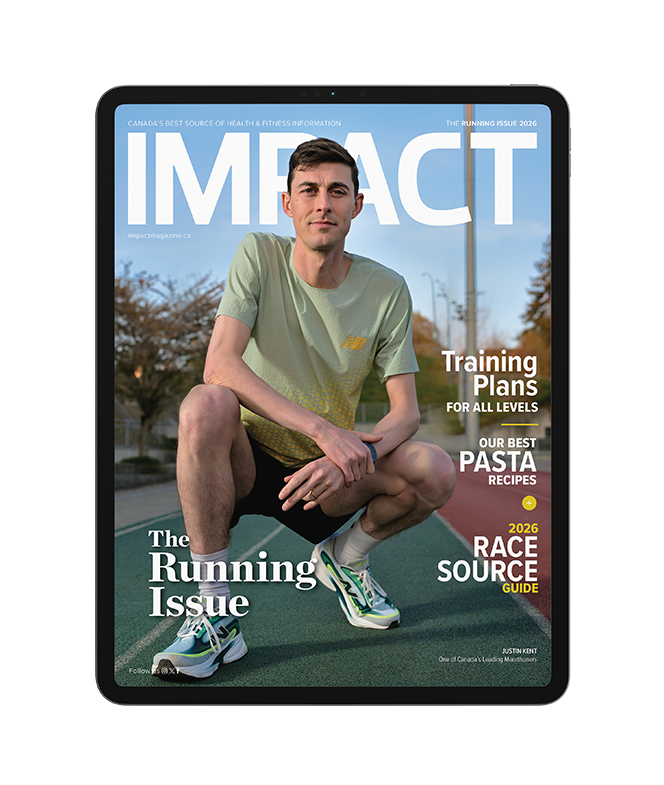
Read This Story in Our 2026 Running Issue
IMPACT Magazine Running Issue 2026 features a rising marathoner quickly climbing the ranks. Discover and travel to your next favourite marathon, prepare for your next big event with expert training plans, and dive into strength workouts and runner-focused articles. Plus, enjoy delicious pasta recipes and so much more.
This just scratches the surface of what you’ll find in this issue, so dive into the DIGITAL EDITION and be empowered for a fantastic 2026!