

Justin Kent attributes the pandemic as the impetus to his transition to marathon running. A middle-distance runner from school-age, when lock-down happened in 2020 the track season was cancelled. He had a few 10-kilomtere runs under his belt so decided to trial a half marathon distance and really enjoyed it.
Then with the absence of the major marathons that year, came the Marathon Project in December 2020, when 40 elite men and 34 elite women came together to run a six-loop course, in the Arizona desert. Kent was one of them, running his first marathon in a credible 2:17: 22 but was disappointed: “It was tough and I hit the wall,” he recalls.
Undeterred and under the tutelage of his coach Richard Lee he continued to train and enjoy his newly found distance. In the fall of 2024, he won the Canadian nationals at the Toronto Waterfront Marathon in a time of 2:12:17. Then riding on a momentum he decided to try for a 2:10 and chose a flat course, the McKirdy Marathon in Rockland Lake State Park, Congers, New York. It ended up being more of a race than he thought: “We had a pacer through to 30 kilometres then the last 12 kilometres it became a race which was awesome. I even did a sprint finish which looking back was crazy. The pace came pretty easy and everything just clicked.”
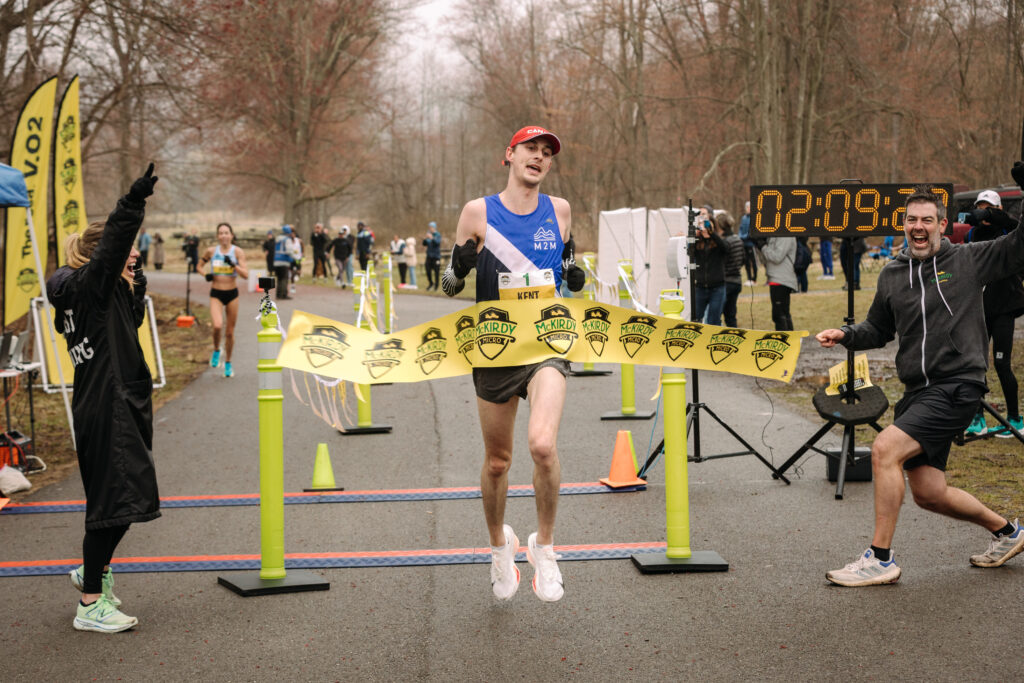
Kent finished in 2:09:29 and became the fourth fastest Canadian male marathoner of all time. (He has since slipped to fifth with Thomas Nobbs clocking a 2:09:25 on the same course last month). “You train for those moments, and it becomes really special.” It was even more special as his father Scott Kent was cheering him on and sharing the moment.
Scott was a collegiate runner, coached son Justin at school in Burnaby, B.C. and founded the Coastal Track Club, one of the many successful running clubs to thrive in B.C.’s Lower Mainland. Growing up in this atmosphere it is no wonder that Kent excelled at running. He did play hockey, baseball and soccer until he was 10, but growing up so near the renowned Harry Jerome track the elder Kent saw his son’s passion, so from grade 11 he started to run more. “Running chose me,” he jokingly says.
Justin always has that ability to tap into his past track background and execute the few higher quality workouts that are still incorporated in the program.
He started in cross-country (“that was a blast!”) then ran the two-kilometre steeplechase, three-kilometres and 1500 metres. “I didn’t have the speed for the 800 metres.” A scholarship to UBC (University of British Columbia) followed with four years running for the Thunderbirds. Under head coach Merek Jedrzejek—who also coached his Dad—he continued running the 1500 metres and steeplechase but also the 4 x 800 metre relay and some five-kilometres races. “He created a unique culture and atmosphere,” Kent says of Jedrzejek, who coached many athletes to Olympic, Commonwealth and Pan-American medals.
After UBC he ran with a post-collegiate group coached by Lee, who at the time was also coaching Dylan Wykes and Natasha Wodak. Coincidentally Lee was also a teammate of Scott Kent when they were athletes in the late 1980s. “So it was easy for Justin to transition to my training as the philosophy and expectations were the same as what he grew up under,” Lee says. “His talent was obvious in high school and Scott instilled a great work ethic in him. Physically he was built to run. Mentally it took a while for him to find the confidence and believe he could be as good as he’s become.”
Kent observes how his training on track is different than long distance. “It changes the dynamic with your coach. Training on a track is so repetitive. Your coach is there calling out splits but it isn’t the same as Rich joining me on a bike for a 40-kilometre run, handing me bottles and chatting. That is something I gravitate towards and is much more enjoyable.” He says his body adapts better to that style of training with more volume but also does attribute it to his years of speed.
Lee isn’t always present at training sessions and praises Kent’s ability to execute and follow his program. “He has a good understanding of what needs to be done and is good at holding himself accountable to achieve the goals of each session. He doesn’t tend to take big risks in training and racing which can sometimes hold one back from making bigger gains.”
Having done a few marathons in a row—he has completed eight—Kent is currently concentrating on shorter distances until the Olympic window opens in December. (Kent has his eyes set on the 2028 Los Angeles Olympics). This year he came second in the First Half in Vancouver (1:03:29) and came first in the Steveston Icebreaker 8K, setting a new course record in 23:06.
He plans on running the Vancouver Sun Run at the end of April, a half marathon in Japan and the Chicago Half Marathon in June.
He trains every day, sometimes twice a day, split between track and road for interval-focused sessions and two long runs clocking in 100 miles a week. He also does two strength sessions in his home gym. His volume will increase at the end of the year when training becomes more marathon focused. Lee says these will be more long, sustained tempo efforts with higher volume—upwards of 160-180 kilometres a week.
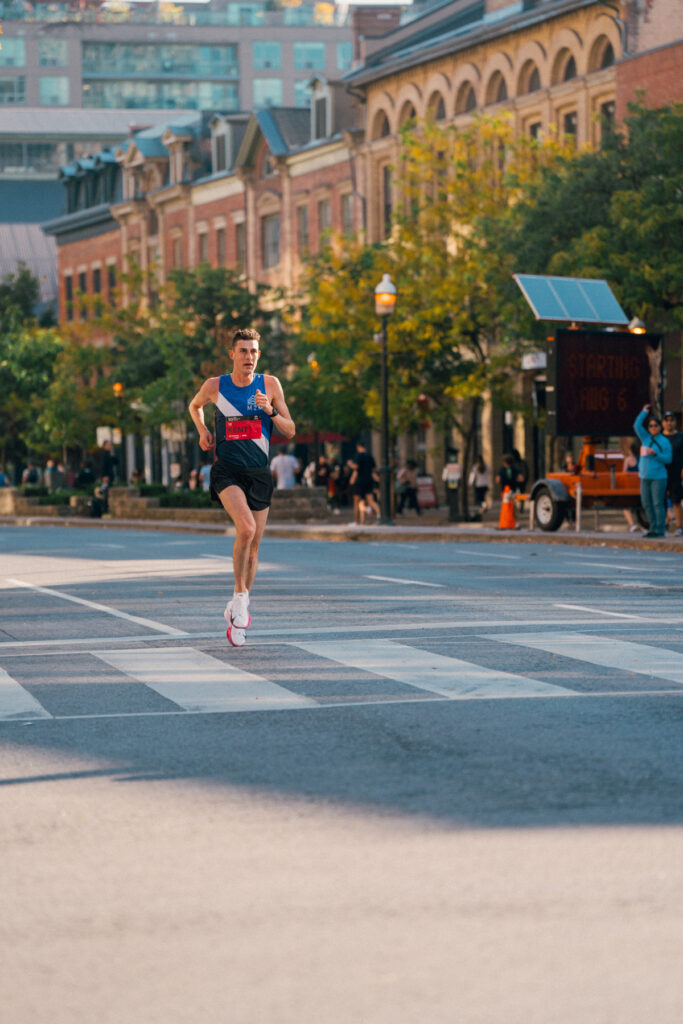
“As an athlete ages, there is less capacity and more high risk in pushing the higher quality workouts. Justin always has that ability to tap into his past track background and execute the few quality workouts that are still incorporated in the program. It’s about staying healthy and carefully picking the times to push things,” he explains.
Kent also coaches on Wednesday nights. Since 2019 he has been a Mile2Marathon coach setting up a group in Burnaby. “It’s a great outlet to share my passion with the support, my learning and mistakes. It’s a big motivator as it normalises what I am doing.”
Despite all the training and coaching he still finds time for his family and holding down a full-time job. Married to 2020 Olympian 800-metre specialist Lindsay Butterworth, they have a daughter, Willa who turns two in May. He is brand manager for Stoko, the performance apparel company, who have been very flexible with his working hours so he can train.
He actually finds his schedule and balance to have advantages. When he knows he has a two-hour window to run, he is focused on getting it done. “Having a time window makes it more purposeful. I can be up at 5 am and out to run before Willa gets up and then log more miles later when she is in bed. I wouldn’t be able to do this without Lindsay’s support.”
With the 2028 Olympics on the horizon does he have a goal? At 34 years of age what is achievable? “My 2:09 time was a signal that I can buckle down and focus. On a good day 2:07 is on the cards if I stay healthy.”
Lee agrees. “Justin hasn’t reached his limits yet with marathon training or racing. Volume-wise he has been on the lower end of what is considered world class for marathoners these days. That’s been by design in an effort to remain healthy. So, there is room for growth and he will certainly have to make that jump and take that risk if he wants to improve from here. Where that ends up is hard to say. Could be 2:07 – 2:08. We’ll find out in the next few years.”
Photography: Connor MacFadyen / Ronald Lee / Julie Porter
You may also like: Cover Stories
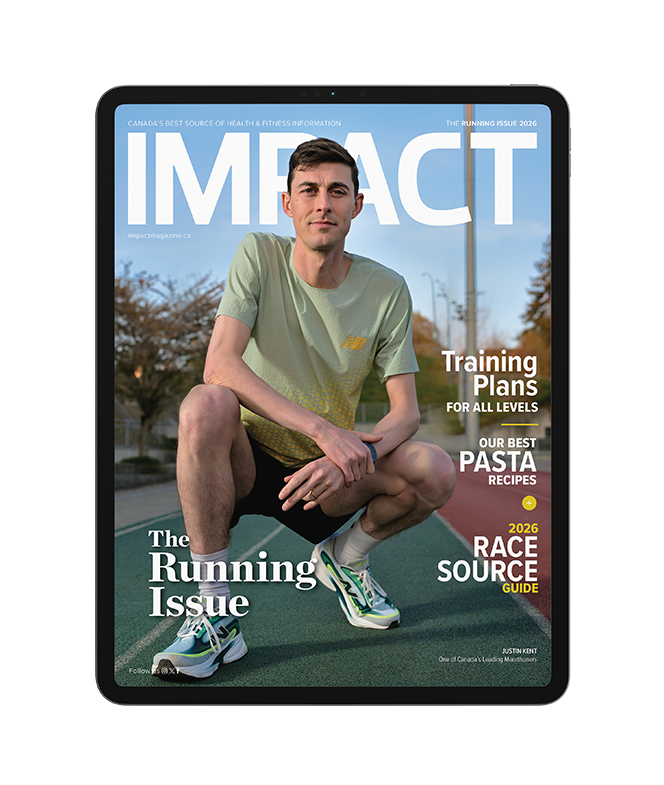
Read This Story in Our 2026 Running Issue
IMPACT Magazine Running Issue 2026 features a rising marathoner quickly climbing the ranks. Discover and travel to your next favourite marathon, prepare for your next big event with expert training plans, and dive into strength workouts and runner-focused articles. Plus, enjoy delicious pasta recipes and so much more.
This just scratches the surface of what you’ll find in this issue, so dive into the DIGITAL EDITION and be empowered for a fantastic 2026!