

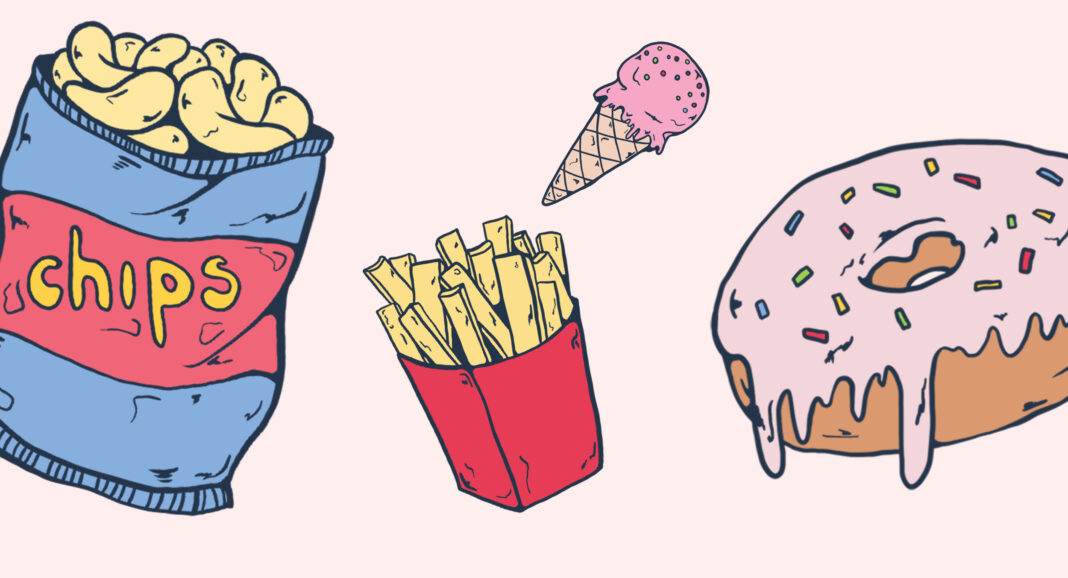
One of the key pathways linking higher intake of ultra-processed foods with increased risk of disease and early death appears to be simple calorie overload, which can lead to excess body fat over time. This may partly be driven by the added sugars and fats commonly found in these products. But controlled research suggests the story is more complex than just “more sugar, more weight.”
In a randomized controlled trial, participants consuming an ultra-processed diet gained more weight than those eating minimally processed foods—even when both diets were carefully matched for nutrients such as fat, sugar, and fibre. In other words, the difference in weight gain could not be explained by nutrient content alone.
One explanation may be the speed at which these foods are eaten. Ultra-processed diets tend to be consumed more quickly, and in the study, participants ate roughly 50 per cent more calories per minute. Faster eating can override the body’s natural fullness signals, making it easier to consume more before feeling satisfied.
Texture and structure also matter. Processing often softens food, making it easier to chew and swallow rapidly. At the same time, ultra-processed foods tend to be more calorie-dense and have a disrupted “food matrix”—the natural structure that helps slow digestion and promote satiety.
Calorie density refers to how many calories are contained in a given weight or volume of food. Some foods pack far more energy into the same space than others. Oil is an extreme example: just one tablespoon contains about 120 calories, yet it barely registers in terms of fullness.
By contrast, those same 120 calories could come from roughly two cups of blackberries—food that physically fills the stomach and takes longer to eat.
This contrast shows up across many common foods.
A handful of jellybeans contains about 16 times the calories of a similar handful of cherry tomatoes. A large serving of French fries can match the weight of a baked potato yet contain roughly four times the calories. In each case, the higher-calorie option is far less filling for the same energy intake.
Overall, ultra-processed foods tend to be about twice as calorie-dense as minimally processed foods, often exceeding 1,000 calories per pound—similar to fast-food patterns.
By comparison, traditional rural diets in parts of West Africa, which are often used as a reference point for more minimally processed eating patterns, average fewer than 500 calories per pound.
This matters because human appetite regulation likely evolved in an environment where people ate several pounds of food per day. If the body is accustomed to a high volume of food for a given number of calories, but modern diets deliver those same calories in much smaller amounts of food, satiety signals may be reached before fullness is experienced.
In practical terms, that means someone could meet their daily energy needs in just two pounds of ultra-processed food instead of four or five pounds of minimally processed food. The question then becomes whether the body interprets that smaller volume as “enough,” even if the calorie target has been met.
This is where interpretation of the original study becomes important. Researchers were able to match the ultra-processed and unprocessed diets for calorie density only by including large volumes of beverage—specifically sugar-free drinks like diet lemonade—to balance out the calculations. One example ultra-processed meal included items such as a deli meat and cheese quesadilla with processed sides, while a comparison meal featured a large whole-food salad with beans, nuts, avocado, fruit, and vegetables.
When beverages are excluded and only solid foods are considered, the ultra-processed diet was still about 85 per cent higher in calorie density. That difference alone could help explain why participants consumed more energy and gained more weight, even under controlled conditions.
Ultimately, the challenge may not be one single ingredient or nutrient, but the combined effect of calorie density, texture, speed of eating, and altered food structure. Together, these features make ultra-processed foods easy to overconsume—without the body registering the same level of fullness as it would with less processed, more volumetric foods.
Reprinted with permission from www.nutritionfacts.org.
You may also like: Healthy Morning Habits

Read This Story in Our 2026 Summer & Outdoor Issue
Canada’s best source of health & fitness information — IMPACT Magazine’s 2026 Summer Outdoor Travel Issue: trail running, outdoor travel, workouts and seasonal recipes.
Featuring world-class French-Canadian ultra-trail runner Mathieu Blanchard, this digital edition takes you coast to coast through Canada’s most unforgettable bucket-list hikes, trail-running tips, and race-day strategies. Build strength and balance with targeted summer workouts, master the taper, and find your footing on technical terrain. Plus enjoy seasonal grilling and plant-forward recipes — Grilled Mexican Corn, Hoisin Portobello Burgers with Chili Lemon Broccolini, Smoky Black Bean Quinoa Burgers — and more outdoor cooking inspiration for active travelers.