
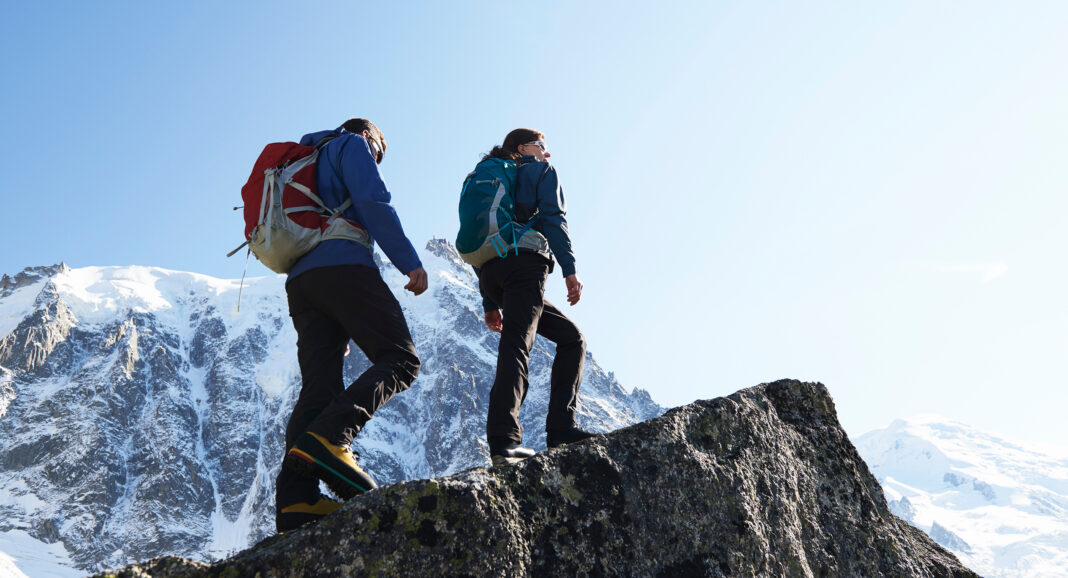
When preparing for a high-altitude trek, people often spend hours researching boots, backpacks, clothing, and itineraries.
While those things matter, far fewer people spend that time preparing the piece of equipment they’ll rely on most: their body.
Altitude doesn’t create weaknesses. It exposes weaknesses that were already there.
Fortunately, there are three key systems you can—and should—train long before setting foot on the trail:
- A strong engine
- A strong body
- An efficient breathing system
Build Your Aerobic Endurance
Long-distance trekking is an ultra-endurance activity. Your success—and enjoyment—will depend on your ability to spend hours each day on your feet carrying a pack.
Altitude raises the energy cost of every step, along with your heart rate and breathing demands.
There are no shortcuts here. Just adding more HIIT to your weekly routine will not build the specific endurance these adventures demand.
To build your aerobic base, spend progressively more time with your heart rate near the top of Zone 2. Without formal testing, Zone 2 is the highest intensity at which you can still speak in full sentences.
Rather than distance, focus on time on your feet. Choose terrain with elevation gain and loss to mimic the long climbs and descents of mountain trekking.
Add 5–10 per cent to your Zone 2 time on your feet each week, with a deload about once per month. For the deload, back off by 25–50 per cent for one week then pick back up where you left off.
Use these sessions to get used to carrying your pack—ideally the one you’ll take on your trek. Start light (~10 lb., or at most 10 per cent of your body weight) and add ~2 per cent each week until you reach your trek weight.
Become Strong Enough That the Trails Feel Easier
Strength training for trekking isn’t about lifting impressive numbers. It’s about making every step use less of your available strength.
Focus on lower-body strength and muscular endurance, with an emphasis on single-leg stability (split squats, step-ups, step-downs), calf work, core strengthening, and shoulder endurance (especially important for making your pack feel lighter).
The result: noticeably less fatigue, better movement quality, and more energy in reserve for dealing with the altitude itself.
Train and Measure Your Breathing Efficiency
We measure strength, pace, and heart rate, yet few people ever measure breathing efficiency.
Most people accept their breathing as something that simply happens. But like strength and endurance, it’s a skill that can be practiced and improved.
You can train the mechanical aspect by breathing primarily with your diaphragm. You can train the chemical aspect by increasing your tolerance to lower oxygen and higher carbon dioxide. And you can train the psychological aspect by staying relaxed when breathing becomes uncomfortable.
One of the simplest tools I use with clients is the Body Oxygen Level Test (BOLT) Score. It isn’t an altitude test, but a snapshot of your breathing efficiency and tolerance to rising carbon dioxide.
Here’s how to check your BOLT Score:
- Grab a stopwatch and take a seat in a comfortable chair.
- Breathe normally through your nose for a few minutes.
- At the end of a natural exhale, pinch your nose and hold your breath (start the stopwatch).
- Hold it until you feel the first distinct desire to take another breath.
- Stop the timer and resume normal breathing.
- The number of seconds = your BOLT Score.
Understanding your BOLT Score:
- 25 seconds or more suggests efficient breathing mechanics.
- Under 25 seconds may indicate dysfunctional breathing patterns and could benefit from assessment with a qualified practitioner (e.g., Oxygen Advantage® Certified Functional Breathing Instructor).
Important: This is not a max breath hold. You should immediately resume normal breathing without needing to “catch your breath.”
Think of your BOLT Score like your resting heart rate: not the goal itself, but a meaningful insight into your current preparedness, and another metric to improve before your adventure begins.
The following breathing technique can be done regardless of BOLT score and can be done as a stand-alone or as the first part of a warm-up routine for a training session:
- Take a normal breath in and out through your nose.
- Hold your breath for 2–5 seconds.
- Breathe normally through your nose for 10 seconds.
- Repeat for 2.5–3 minutes.
Most successful trekkers aren’t exceptional athletes, but they are incredibly well prepared.
The goal isn’t simply to reach the summit or the mountain pass. It’s to have enough left in the tank to enjoy the experience, appreciate the view, and return home with lasting memories.
Five Bucket-List High-Altitude Treks
- Salkantay Trek, Peru (4,630 m)
A spectacular alternative to the Inca Trail, combining glaciated peaks, cloud forests, and a dramatic finish at Machu Picchu. - Mount Kilimanjaro, Tanzania (5,895 m)
The world’s highest free-standing mountain and one of the most accessible high-altitude summit experiences. - Everest Base Camp, Nepal (5,364 m)
A legendary journey through Sherpa culture to the foot of the world’s highest mountain. - Annapurna Circuit, Nepal (5,416 m)
One of the world’s great trekking routes, offering incredible cultural diversity and the challenge of crossing the Thorong La Pass. - Cordillera Huayhuash Circuit, Peru (~5,000 m)
A remote, high-alpine adventure often considered one of the most spectacular trekking circuits anywhere on Earth.
You may also like: Running at Altitude
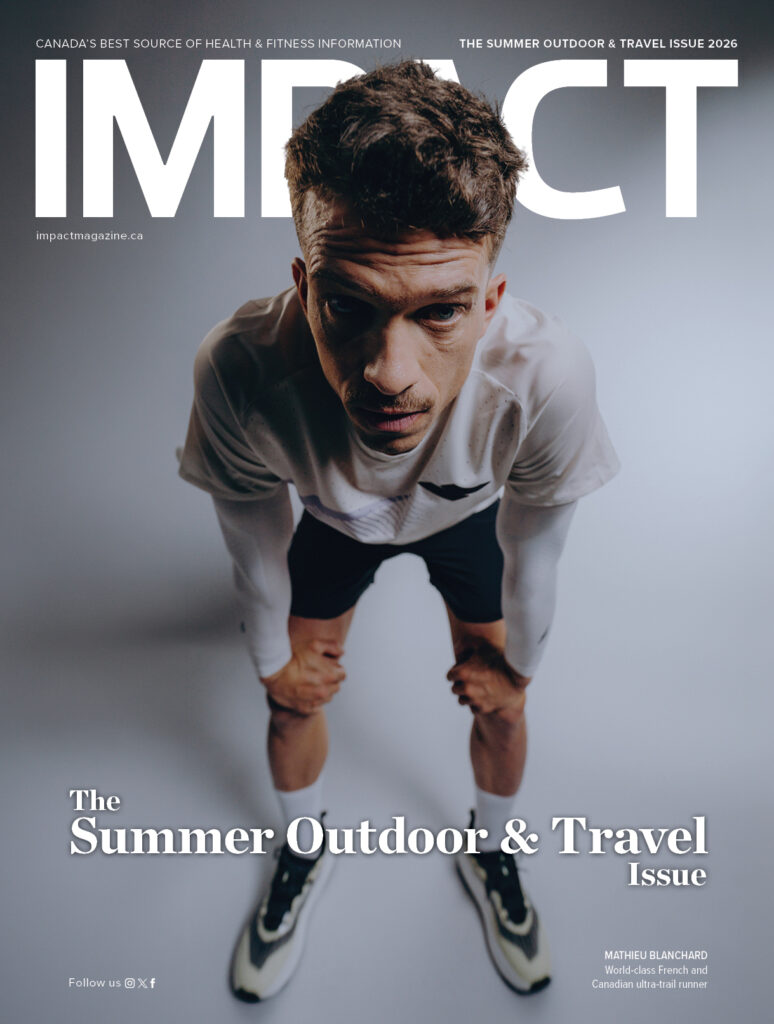
Read This Story in Our 2026 Summer & Outdoor Issue
Canada’s best source of health & fitness information — IMPACT Magazine’s 2026 Summer Outdoor Travel Issue: trail running, outdoor travel, workouts and seasonal recipes.
Featuring world-class French-Canadian ultra-trail runner Mathieu Blanchard, this digital edition takes you coast to coast through Canada’s most unforgettable bucket-list hikes, trail-running tips, and race-day strategies. Build strength and balance with targeted summer workouts, master the taper, and find your footing on technical terrain. Plus enjoy seasonal grilling and plant-forward recipes — Grilled Mexican Corn, Hoisin Portobello Burgers with Chili Lemon Broccolini, Smoky Black Bean Quinoa Burgers — and more outdoor cooking inspiration for active travelers.