
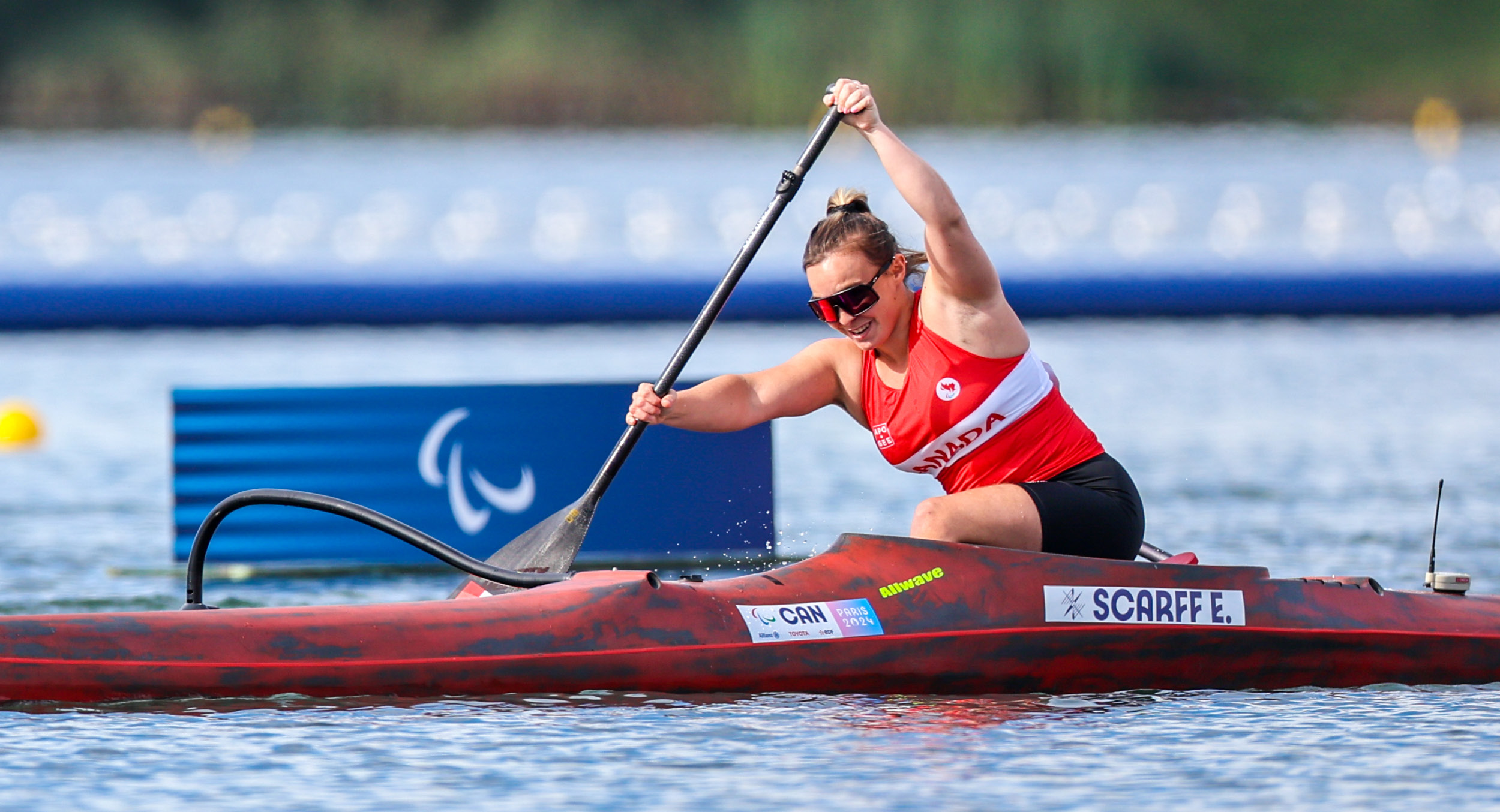
Paralympian Erica Scarff is no stranger to adversity and when many would have thrown in the towel, she continues to paddle forward.
At 12, Scarff was a competitive gymnast but one day everything changed. She was sprinting towards the vault at practice and heard something pop, followed by a tremendous amount of pain. Her coach came running and called her parents to take her to the hospital.
“He actually had to carry me out of the gym. I was in so much pain,” Scarff recalls.
But because the pain was coming from her thigh, the doctor at the hospital didn’t think she’d broken anything and was going to send her away without an X-ray. Her mom knew her pain tolerance and pushed for that X-ray. It not only showed a broken femur but also a shadow.
That led to the diagnosis no family wants to hear—cancer—specifically osteosarcoma, the rare bone cancer Terry Fox was also diagnosed with three decades before.
The treatment was aggressive and she underwent 60 rounds of chemotherapy during the course of a year and, like Fox, had to have her right leg amputated. “Chemo is really tough, it makes you feel completely awful,” she says. “My mom would always bring a blanket from home to comfort me.”
When the time came to amputate her leg, Scarff remembers being resigned to the decision. “When I was going through my cancer treatment, I accepted it, I wasn’t happy about it but I took it in stride.”
Her battle prompted family friend, Sue Strong, to start Erica’s Wish as a way to support her and her family. The initiative’s blanket program continues to bring warmth, comfort and hope to children facing the biggest battles of their lives. Initially, Strong delivered blankets in Toronto to the Hospital for Sick Children (SickKids), where Scarff was treated, but now sends them across Ontario.
Scarff has gone on some of those deliveries. “It can be hard to go back to SickKids but there’s also a lot of positive things that happened there.”
“I instantly fell in love with the sport. I really enjoyed being in the boat and leaving my prosthetic on the dock.”
Without her treatment, Scarff wouldn’t be on the course she is now, and for that, she’s thankful.
Once in remission, it was a chance encounter that led her to compete on the world stage. “The thing I was really missing was that sport and competitive aspect,” Scarff says. While her parents tried to help her find something to fill the void left by gymnastics—swimming, biking, downhill skiing—she didn’t love anything.
One day she was at the prosthesis clinic when she ran into a friend who happened to be there with coach Mari Ellery. Ellery suggested she try Para canoe. “I instantly fell in love with the sport. I really enjoyed being in the boat and leaving my prosthetic on the dock.”
Now in her late teens, she used that first summer to ease into the sport, competing in a few races. But that fire was reignited and, with Ellery as her coach, she quickly started pushing herself harder.
It was around that time it was announced Para canoe would debut at the 2016 Summer Paralympics in Rio de Janeiro. “Once I saw I had the potential, I put a lot of pressure on myself,” Scarff recalls. “I started training even harder to see what could happen.”
She made her Paralympic debut alongside the sport she’d fallen in love with. “It was really cool to see so many other disabled athletes from around the world. It was a really positive experience.” A seventh place finish spurred her passion and she set her sights on Tokyo 2020.
But Scarff was dealt another devastating blow. She was crossing the street in 2018 when she was struck by a car. “It was pretty terrible but when I look at it in the grand scheme, I’m quite lucky it wasn’t worse,” Scarff says.
The recovery derailed her training and her life. In her early twenties at that time, she had recently moved out on her own and was attending school. Instead, she was forced to move back home and couldn’t wear her prosthesis. “It took me a really long time to recover.”
When she was finally able to get back in a boat, Scarff says it felt like she was starting over.
Despite clawing her way back, she narrowly missed qualifying for Tokyo. Still, she continued on and then it was announced Para canoe events would be expanding for Paris 2024.
There are two main boats in Para canoe: kayaks (propelled by a double-blade paddle) and va’a boats (an outrigger canoe propelled by a single-blade paddle). Up until this point, Scarff had been competing in kayaks. “I decided to switch events and see if I could qualify.” That came with another set of hurdles as she learned the ins and outs of a different event.
The move provided some of her biggest career highlights, seeing a gold medal finish at the 2022 World Cup, a silver medal at the 2023 World Championships and a fifth place finish in Paris.
The 2024 Paralympics were a redeeming moment for her, she says. Not only did she get to compete in Paris, but it felt like her hard work had paid off after missing Tokyo.
Another notable moment came for her this summer at the 2025 World Championships in Milan—the same city she competed at her first worlds in 10 years ago. This time her parents were able to accompany her and watch her eighth place finish live.
“I’ve been in the sport so long, it’s really cool to see things come full circle like that.”
Photography: CKC/Vera Bucsu
You may also like: Athletes with IMPACT
Read This Story in Our 2025 Fall Fitness Issue
IMPACT Magazine’s Fall Fitness Issue 2025 featuring the The Fitness Guy, Pete Estabrooks, telling all with his shockingly candid new memoir revealing a story you never expected, as well as former pro soccer player Simon Keith and Paralympian Erica Scarff. Find your ultimate guide to cross-training for runners, no jump cardio and superset workouts along with the best trail running shoes in our 2025 Trail Running Shoe Review, and so much more!