

Simon Keith remembers exactly when and where everything changed.
Harbouring no emotional expectations, he had travelled to Wales in 2011 to visit the gravesite of the teenager whose heart was beating in his chest. But that day, looking at the headstone in the cemetery and standing beside the father of the organ donor, Keith was moved beyond words.
He felt his own life shift.
“I definitely had an epiphany.”
A quarter-century earlier, the transplant had saved Keith. But back then, bringing together the families of organ recipients and donors was not commonplace. “The thinking was, ‘If you dare to reach out, that will open the wounds and they’ll have to relive the trauma,’” he says. “The philosophy was that you had to keep everyone separated.”
But the former soccer star—in the process of writing a book about being the first person to play professional sports after heart-transplant surgery—realized he needed to know more about the gift’s origins, even decades later.
So, Keith arranged that overseas trip to pay his respects to donor Jonathan Groves and their heart’s history. “I hadn’t thought much about the family and the young man who’d passed away,” he says. “Up till that time, my competitiveness was focused inward — I need to do this, I need to do this, I need to …”
People wired like me are so competitive and so driven, nothing that happened yesterday is relevant. It’s always, ‘What’s on the horizon?’
But, jolted by the graveyard experience, Keith’s me-first approach vanished. He was inspired. “It was, ‘I’m going to change — I’m going to do for others.’”
Energized by the possibilities, he established the Simon Keith Foundation with his wife, Kelly, to help young organ recipients return to active lifestyles and to raise awareness about donor registration.
Committed to advocacy, he openly shares his powerful story with dozens of audiences every year. “It’s really mission driven and it’s really for those kids.”
He recently hosted the Simon Keith Foundation Heart of Gold Gala and Concert, a red-carpet event in Victoria, B.C. that generated $3 million in donations. “We’re definitely going to do more galas. Maybe in Montreal, Toronto, Calgary, Vegas, New York, who knows?”
Trust him to figure it out. Because Keith—born in England, raised in Victoria, settled in Las Vegas—isn’t one to sit still. “People wired like me are so competitive and so driven, nothing that happened yesterday is relevant. It’s always, ‘What’s on the horizon?’”
That full-steam-ahead mentality has served him well.
As a blossoming soccer player, he had been determined to crack Team Canada’s lineup and participate in the 1986 World Cup. Ever gung-ho, he was on pace, until, as a 19-year-old striker of the University of Victoria, he got a diagnosis of viral myocarditis. Without a new heart, he was dead.
The wait was excruciating. “Soul-sucking, dark, lonely, a terrible place to be,” Keith says. “Groundhog Day every day. You can’t think about anything else. You can’t eat. You can’t sleep. It’s where character is born, that’s for sure.”
Eventually welcoming a donation—Groves, only 17, had perished while playing soccer—Keith was immediately obsessed with the goal of returning to the pitch. His surgeon, Sir Terence English, encouraged him, saying go ahead and “resume the life you led prior to being sick.”
Music to his ears. “That became my North Star.”
Three years later, while starring for the University of Nevada-Las Vegas, he was selected No. 1 in the Major Indoor Soccer League’s draft by the Cleveland Crunch. Soon after, he became the first post-heart-transplant professional player—in any sport. “Ability, perseverance, stupidity, whatever you want to call it, I’m really proud,” says Keith, who, later, suited up for the Victoria Vistas, Winnipeg Fury and Montreal Supra of the Canadian Soccer League. “It happened.
I was there, man. I know how hard it was.”
He has barely slowed. Earlier this year, against all odds, Keith celebrated his 60th birthday. “Every day is uncharted territory. What’s up? What’s next?” It’s no surprise to hear that he runs and cycles, lifts weights and plays tennis, golfs and cheers for his beloved Vegas Golden Knights. He carries on like someone half his age.
“I’m in a world where just being me is really fun.”
His remarkable journey is ongoing, but Keith acknowledges that he’s taken time to reflect, to consider the mark he’s making.
He’s been immortalized numerous times—Order of Canada, David Foster Foundation Visionary Award, inductions into assorted halls of fame—so one would blame him for puffing out his chest, which, by the way, contains his third heart after a 2019 procedure that also included
a kidney transplant.
But his outlook is decidedly selfless.
“The reality? I’ll be viewed as someone who did something that no one else had done before, which is great, but it’s not the legacy I want,” says Keith. “I’m hoping there’s people in the world who have been helped, who have changed their perspective, through an interaction with me or my family or my team. That’s what I ultimately hope.”
Photography: JerryMetellus
You may also like: Athletes with IMPACT
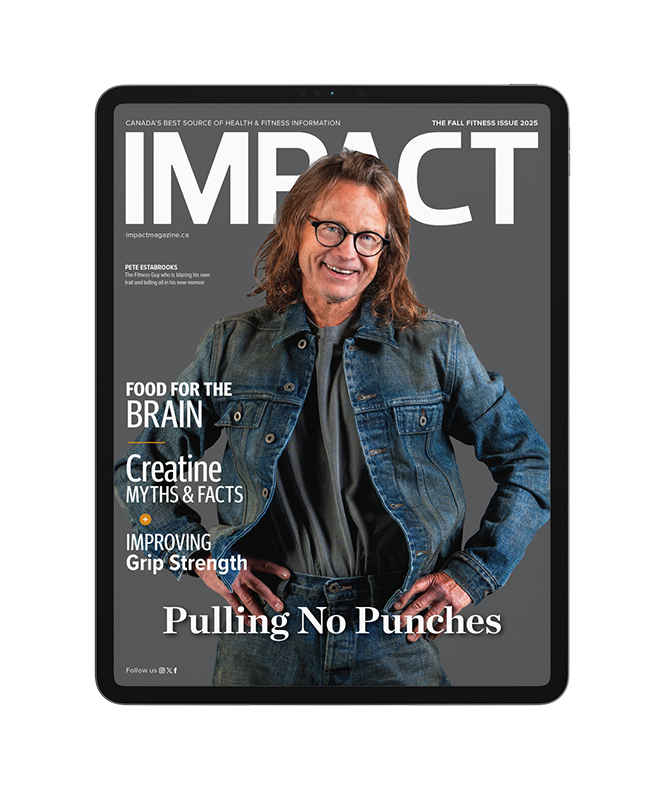
Read This Story in Our 2025 Fall Fitness Issue
IMPACT Magazine’s Fall Fitness Issue 2025 featuring the The Fitness Guy, Pete Estabrooks, telling all with his shockingly candid new memoir revealing a story you never expected, as well as former pro soccer player Simon Keith and Paralympian Erica Scarff. Find your ultimate guide to cross-training for runners, no jump cardio and superset workouts along with the best trail running shoes in our 2025 Trail Running Shoe Review, and so much more!