

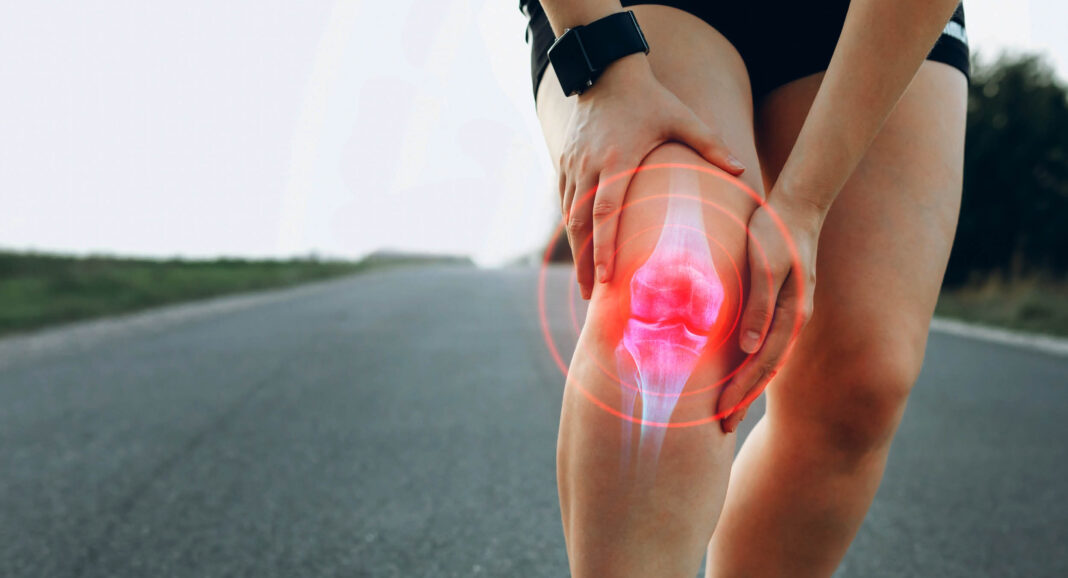
If you’ve ever told someone your knee hurts while running, you’ve probably heard one of two things: stop running or just push through it. Knee pain is one of the most common complaints among runners, and the good news is that with the right approach, most people don’t have to choose between those two extremes.
What Causes Knee Pain?
Runners might be quick to blame shoes or running form, but knee injuries are much more complex. Factors like training load, injury history, lifestyle stressors (sleep, nutrition), and biomechanics all need to be considered. These tend to fall into three categories:
- Too much too soon: running injuries may pop up after a large spike in distance, volume or intensity compared to previous training.
- Too little recovery: sleep, nutrition, fueling, and stress management all contribute to how well the body adapts between sessions.
- Too little preparation for the demands of running at that point in time: when load and recovery are mismatched, the body isn’t ready for what’s being asked of it, which can lead to pain or injury.
Types of Knee Pain
Patellofemoral pain (PFP), known as Runner’s Knee, is the most common. This usually presents as diffuse pain at the front of the knee, sometimes behind the kneecap (the patella).
Other common types of knee pain are:
- Iliotibial band (ITB) pain: usually sharper pain at the outside of the knee, experienced during bending and straightening.
- Tendinopathy of the patellar tendon, at the front of the knee below the kneecap, or the pes anserine, the insertion of three tendons at the inside, front aspect of the knee. Tendon pain usually feels stiff and painful initially but can warm up during activity.
With the right treatment, most runners can manage these conditions and stay on their feet.
How to Return to Running
Seeing a physiotherapist early can help clarify which type of knee pain you’re dealing with, rule out anything more serious, and build a load management plan tailored to your training.
Recovery from knee pain isn’t a single fix. Start by calming down the pain, without needing to stop running. Then build up your ability to tolerate more load. Use these treatment options to manage your knee pain and find what works best for you.
Change up your running routine
Reduce loads on the knee in the early stages by including incline running on a hill or treadmill. This can help to move the running forces from the knees to the ankle complex. Ensure you don’t overdo this type of training if you are not used to it as it can increase loads on the Achilles tendon and calf muscles.
As your knee pain improves, slowly reduce incline runs. Increase flat-ground running while avoiding pushing into too much fatigue. Lastly, reintroduce running downhill.
Add in quadriceps and hip exercises
The knee joint can take up to 5x bodyweight in forces during running—the quads, 1-2x. While weakness may not be a direct cause of knee pain, the quads still play a critical role in decelerating the leg and producing force to counter the ground reaction forces of running.
Early on, start with a stationary exercise like a wall sit, working up from 10 seconds to 30 seconds. Then build up to a lunge to challenge the single leg. Use a slow lowering of three seconds to work on the eccentric strength of the quads: key for deceleration and downhill runs. As you progress, add weights.
Hip muscle weakness is not necessarily a cause of knee pain, but when the knee is sore, it is useful to work other supporting muscles. Try these exercises for your hips:
- Side plank from the knees or feet to target the side glutes (gluteus medius)
- Single-leg glute bridge to challenge hip stability and target the main glutes (gluteus maximus)
Work on plyometrics
Running is a repeated springing action, and plyometrics train the lower leg to do that job more efficiently, taking load off the knee. Skipping for one to two minutes before a run is a good starting point. Or try double hopping on the spot, progressively trying to jump higher while keeping contact time on the ground as short as possible. Then you can progress to single leg as your knee pain improves.
Temporarily change running technique
While there’s no single best running form, a heel-strike places more load through the knees, and a forefoot strike shifts demand to the ankle and calf. For knee pain, temporarily increasing your cadence by seven to 10 per cent can nudge the body towards a forefoot pattern, moving forces away from the knee while it recovers. Once the pain settles, ease back to your natural rhythm, the one your body has adapted to.
Running is not bad for your knees
The knee was built to take load. It has cartilage that can adapt to loading, a meniscus that helps to distribute the forces in the knee, and large contact areas to help with the demands of running. Running may even be protective of the knee joint.
The knee is more capable than most runners give it credit for. With the right modifications and a bit of patience, you can stay running and build knees that are more resilient.
You may also like: Knee Mobility
Read This Story in Our 2026 Running Issue
IMPACT Magazine Running Issue 2026 features a rising marathoner quickly climbing the ranks. Discover and travel to your next favourite marathon, prepare for your next big event with expert training plans, and dive into strength workouts and runner-focused articles. Plus, enjoy delicious pasta recipes and so much more.
This just scratches the surface of what you’ll find in this issue, so dive into the DIGITAL EDITION and be empowered for a fantastic 2026!