
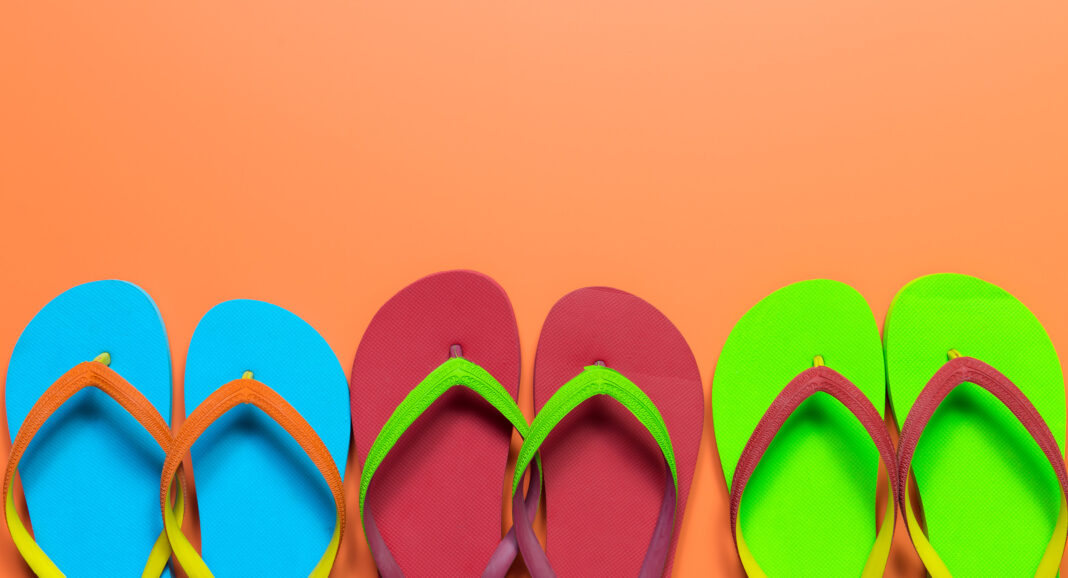
Summer’s here, and that means it’s officially flip-flop season—but before you slide into those easygoing sandals, let’s take a minute to look at how they might be affecting your gait, muscle function, and performance.
When you wear shoes that don’t fully connect to your foot, your toes and feet have to work differently to hold the shoe on when you’re walking. For runners and athletes, this change in foot mechanics can have ripple effects throughout the body.
It’s easy to assume that flip-flops are the very epitome of minimal footwear. After all, what could be more minimal than a rubber thong attached to a foot-shaped rubber pad? Like the best barefoot shoes, they’re flat, wide, and flexible. They’re also “open”—an important component of the “natural” argument, as they allow for greater sensory input in the form of air pressure and temperature.
It’s true, flip-flops are so close! But they fall short of being minimal-for-the-purpose-of-natural-gait in a vital way—they don’t connect to our feet. For athletes who depend on efficient, repeatable gait patterns, that missing connection can compromise performance and increase the risk of small, compounding injuries. We have to work our muscles unnaturally to keep them on. (Unfortunately, this toe-gripping action is necessary for slides, mules, and many slippers, too.)
I know, I know… gripping doesn’t sound or even feel like such a big deal, but gripping while you’re walking is more than just toes bending in different places. Those bends end up translating into mechanical input at the level of the nerves and skin and, over time, can create many problems not filed under “musculoskeletal.”
The grip to keep footwear on curls some toe bones up and some down, drives the end of some bones into the ground creating higher-than-normal pressure (hello fracture-potentially-in-the-making!) and drives the ends of some bones up into the top of the shoe (file under: corn, calluses). I won’t even mention the tension down the front of the leg—you’ll find it yourself during this top-of-the-foot-stretching exercise that helps undo the chronic tension in both the toes and in the front of the ankle.
TOP OF THE FOOT STRETCH
If you’re a chronic flip-flop wearer, then this super portable stretch is especially pertinent to your feet and targets not only intrinsic foot muscles but extrinsic ones as well. Do it a few times every day until your feet regain their intended dexterity and/or until you’ve eliminated any cramping.
- Stand on your right foot and reach your left foot back behind you, tucking the toes of your
- left foot under and placing them on the floor.
- If you find yourself leaning forward, shorten the distance you’ve reached the leg back.
- Bring your pelvis over your standing ankle and upper body over the hips.
- Work up to holding this stretch for a minute, but stop for cramping.
After a while, the toe-gripping motor pattern leads to shortened toe muscles (and a loss of parts that allow movement), which can then affect things like balance and foot arch strength, and lead to toe contractures, a.k.a hammertoes. And flip-flop research also shows that working to keep the shoe on changes many things about your gait, which means they end up affecting more than the feet.
Now I like spring and summer shoes as much as the next person, but I also like my feet to feel great and to be able to walk—or run—long distances without pain. For runners and other athletes, maintaining natural gait patterns and strong foot mechanics is especially important, and flip-flops can quietly undo a lot of that work by encouraging dysfunctional movement patterns. So, I’ve swapped out all my slide-on sandals for ones that have a strap around the back.
To keep your natural stride (and shoe) on while still enjoying the feel of the sea breeze and sunshine on your skin, swap out those slide-on sandals for something that looks more like a Greek sandal—you know, all strappy and minimal but still fully connected to your foot. If you look around, you can find uppers that are very minimal as far as mass goes, but engineered in a way that keeps the shoe on without you needing to tighten your toes.
Adapted and edited for length from Katy Bowman’s book Whole Body Barefoot (Uphill Books, 2015).
You may also like: IT Band Exercises for Runners
Read This Story in Our 2025 Summer Outdoor Travel Issue
IMPACT Magazine Summer Outdoor Travel Issue 2025 featuring Shanda Hill, a Canadian Ultra Triathlete who is redefining the sport. Run on some epic trails in our own backyard or join a run club. Eat your way for Mental Clarity, fueling while travelling, seasonal eating and some kitchen must haves. Become strong and fit in only 20 minutes a day, and enjoy some tasty drinks guilt free and so much more.