
Technology Over the Long Run
By Dr. Syl Corbett
Back in the good ol’ days of running purity and simplicity where all you needed was a pair of tennis shoes, has evolved to a literal fast forward of technology changing not only our shoes, but our apparel, our training tools, how we measure our performance and monitor our physiological response to the demands of the ever-changing fitness landscape.
Footwear Choices
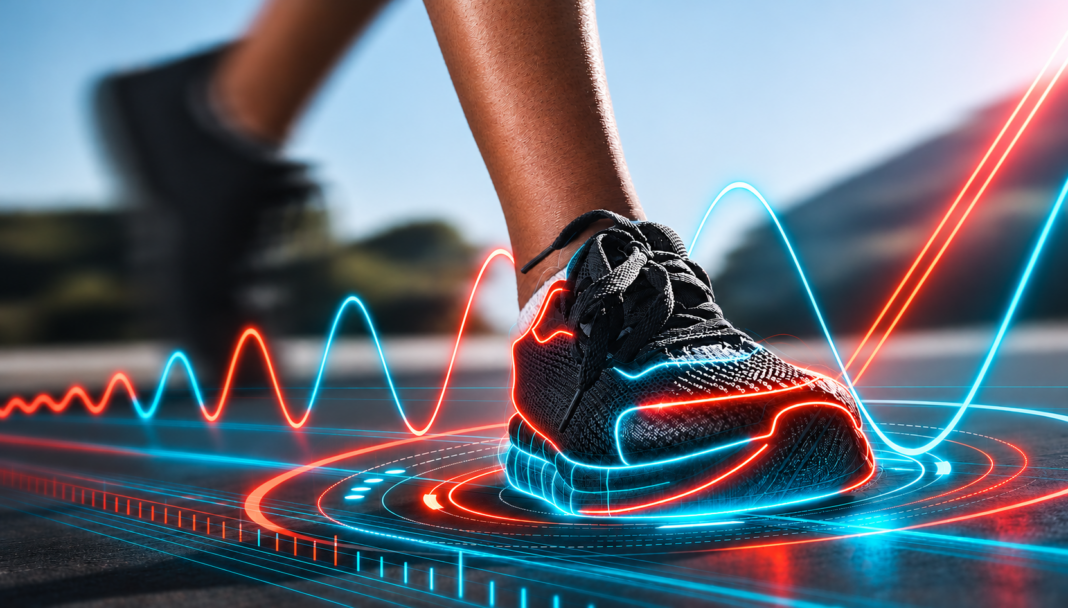
Footwear started from a novel waffle soul to a present-day proprietary gas-infused midsole with an embedded carbon fibre plate that abets a propulsion forward. The trends went from a minimalist style, to one with a maximum cushioned 40 mm stack height, back to a barefoot runner, and now offering a match for everyone’s preference and style.
Shoes have become lighter with increased breathability, better traction and comfort, and of course have become more expensive. Most running and fitness footwear is north of $150 and goes as high as > $400! Insoles went from paper-thin to plush, to orthotic infrared inserts supporting the foot.
“Shoe technology has changed more in the past five to seven years than in the previous two decades,” says Jeremy Deere, former elite runner and owner of Strides Running Store in Calgary. “New technologies such as super-foams, carbon plates, increased stack heights, etc. have taken over from ‘gimmicks’ like Air and Gel.”
Deere has seen a decline in stability shoes over the last 10 years. “This may be due to changing shoe technology, recommendations from health care professionals or just customer preferences.”
According to Lindsay Housman, Founder & CEO, Hettas: “The biggest shift in running shoes isn’t the super foam or the carbon plate. It’s that we can now study how a specific runner moves and design for them.”
The ‘toe-off’ feature that some shoes have can give a biomechanical advantage, but it can also affect gait and potential injury. With the advancement of footwear, research on injury rates is inconsistent with some higher and some lower. Unfortunately, a reduction in training or cessation until healed is commonplace for an impact activity and reliance ‘solely’ on our fancy kicks doesn’t appear to solve all our running related ailments.
Trail shoes have also evolved over the years as more and more runners are going off road. “The breadth of trail footwear offerings has increased, from lower profile racing-style shoes, to max cushion shoes, to the newer, gravel shoes, designed as a hybrid for roads and trails,” says Deere.
“Whether someone is exploring their first trail or competing at the highest level, our goal is to give them the confidence, comfort, and performance they need to get the most out of every experience,” says Joe Toth, General Manager and Vice-President of the Americas, Altra. “That’s why we’ve invested in better foams, grippier outsoles, and more specialized models designed for different runners, terrains, and distances.”
Variety of Clothing
Alongside footwear, athletic apparel has evolved from basic cotton through changing colour trends from drab to neon to subdued, to sophisticated, to high-tech polyester fabrics. Features now include automated ventilation, graphite textiles for enhanced cooling, and materials that detect movement and provide physiological feedback. Evidence that these garments improve performance is limited, but their added comfort is undeniable. Compression garments, thermal layers, wind-resistant shells, and breathable fabrics offer options for varied activities and weather conditions leaving fewer excuses to skip outdoor training year-round.
The biggest shift in running shoes isn’t the super foam
or the carbon plate…
Wearable Technology
A study conducted by ACSM this year surveyed 1,433 fitness professionals around the world regarding trends influencing their day-to-day programming and strategic decision-making. Wearable technology figured prominently globally appearing in the top 20 in 15 countries.
Far more elaborate than the basic stopwatch, GPS devices now not only tell time of day and the duration of the workout, but so too, a plethora of information to describe our performance. From the heartrate, that used only to be detected with a chest strap, can be a wrist-based capture with audio alerts to ensure we are in the appropriate zones.
GPS is now a routine feature recording routes, providing maps minimizing our chances of getting disoriented in the beauty of our environments. Our mechanics including; cadence, stride length, ground contact time, vertical oscillation, and power are available right from your wrist. No need to go to a lab to get an estimate of your caloric expenditure, 2max and your predicted race time finishes, some even provide approximations for lactate threshold.
Should you need a workout, devices can offer suggestions of what to execute. From training plans to recovery analysis, your watch has physiological proof of your readiness status. Sleep tracking further arms you with useful data to quantify recovery. Multiple activities can be accounted for and settings can be switched to accurately log your efforts. The watch can be paired with other devices such as chest straps, power metres, cadence sensors, phones, etc. As for increased safety, live location sharing, incident detection, emergency contacts, etc. justify its utility. Even the simplest fitness trackers offer enough data to get the weekend warrior moving in the healthier direction.
An amazing novel and innovative tool we now have monitors our hydration and electrolyte levels. A small sensor attaches to a disposable patch on the skin and sends real-time information to a connected app, providing personalized guidance on when and how much to drink. Unlike general hydration recommendations, this technology responds to your individual sweat patterns during a workout eliminating any guesswork. It can help inform hydration strategies for various intensities and environmental conditions, an invaluable tool in training and racing.
Biomechanics
So too, gait analysis has undergone an explosion of technology. From a coaches’ eye to an AI 3D markerless motion capture, there is little guess work and few obstacles to diagnosing limitations. Metrics provide insight that was inaccessible before and helps to home in on specific issues that may avert an injury from occurring.
“The convergence of markerless 3D motion capture, advanced biomechanics and artificial intelligence is transforming how we understand human movement,” explains Pat Hamilton, Founder of Yana Motion Lab, Calgary, AB. “Complex biomechanical data can be turned into meaningful, actionable insights that help people move better, recover smarter and stay active longer.”
Interpretation and implementation are critical to take advantage of and reap as much as possible from this ‘heart pounding’ evolution. A coach may help you use these tools and navigate through what can be overwhelming information.
For the past 35 years our industry has morphed into an exciting field of fitness innovation. A caveat with all this data is losing touch with oneself, the ultimate dictator of performance. The best recommendation is to balance the technological advances made over past few decades, learn from its wisdom… and perhaps reap the benefits along your fitness journey!

Running: From Boom to Boom!
By Louise Hodgson-Jones
The popularity of running has seen a boom over the last three decades: running clubs, clinics and races are continuing to rise; coaching is seeing a hybrid of in-person and online and many are seeking nature on the trails and in the backwoods.
Jim Fixx and Jeff Galloway popularized running from the 1970s through to the 1990s making it a ‘doable’ activity for anyone. The run/walk concept—often called ‘Jeffing’ after its founder—became the norm for many starting out on their running journey. Some could say this was the start of the social aspect of running where completing a distance by time became more popular than by distance.
Now schedules are often done by time and running three or four times a week is enough to train you for a marathon. Is the 80-100 mile week a thing of the past? Perhaps says Rob Reid, the Victoria-based philanthropist, and owner of New Balance and Frontrunners, who ran a 2:22:10 PB in 1981 in Toronto. “It wasn’t unusual to do a 20-mile run every weekend and run almost every day—and fast. Now the social component is as important as the performance aspect, which is why there are so many run clubs.”
Clubs and clinics have seen a surge in interest since COVID. Jeremy Deere has seen the run clubs at his three Strides Running Store locations tripled. The world-wide park run movement doesn’t seem to be slowing down and as more runners establish goals, race-specific run clinics are on the rise.
“More runners, especially new runners, want guidance and are looking for help with their running. Joining a clinic typically means you’re surrounded by similarly experienced runners and removes the intimidation factor, or at least decreases it,” says Melissa Paauwe, owner of Calgary’s We Run the World Coaching.
“Many new runners are looking for knowledge and expertise as well as connection through an established program,” says Nick Walker, owner of Frontrunners Victoria which has one of the largest run clinics in North America.
Clincs can offer training schedules with organized group runs, nutritional advice, expert advice on shoes, GPS devices and clothing. But the biggest bonus is running with like-minded individuals all with a common goal.
Those who are self-motivated have found that on-line coaching works. “Online coaching has increased since COVID. Some runners prefer to train individually—allowing for more flexible schedules—and an online coach allows this, sometimes at a lower cost than meeting a group in person,” says Deere. And then there are the apps—download a schedule and all you have to do is follow it.
Shift in Demographics
What has seen a steady growth over the years, is the percentage of women running. Statistics Canada in 2023 cited 57 per cent of runners were women. A similar trend was recorded by Sport England in the U.K. in 2016 at 51 per cent. However, Running U.S.A. in 2022 recorded only 36 per cent were women—a surprising statistic since women are often the largest demographic in races. (This disparity could be explained as location such as physical safety and running at night).
But globally women are donning running shoes and entering races. “They represent a significant share of our participants, and we continue to see strong appetite from women who are new to the sport or ready to take on a bigger distance,” says Kirsten Fleming, CEO of Run Calgary.
Running is having an extraordinary cultural moment…
It is often the social aspect that attracts women: “Many women are moms, have careers and have very busy lives. Running is a small part of the day they can carve out for “me-time” and socialize with friends or get some alone time. I don’t see this coming to an end,” says Paauwe.
The demographic shift is also being seen in multisport races. Once the domain of the 40-45-year age group, Tom Bamford from Platinum Racing is seeing a change. “The only real growth is the 25-29 year old demographic doubling in size year over year at all events. Ironman is seeing the same occurrence globally. It will soon become our biggest five-year age group.” But there are challenges. “Now we have to think of ways to keep the athletes coming back. They are more experiential than competitive.”
Organisations like Run Calgary are facing another growing demographic. “We hired our first ever adaptive athlete coordinator helping us with adaptive athlete work, we do significant run-crew engagement and community outreach all designed to remove specific barriers to participation. Inclusivity doesn’t happen by accident,” explains Fleming.
Hitting the Trails
A wider demographics range is having an influence on the rise of trail running. While cross-country running was often instilled in us growing up, we left it behind to explore roads. Now many are realizing that running on a softer, more forgiving terrain is good for the body and soul. Once again COVID was a factor when running bubbles developed and it was safer to run miles from anyone and away from prying eyes! And it was a lot of fun!
“Trail running removes the pressure with pace that often comes with road running. I see long-term runners looking for new challenges going this route as well as those over chasing personal bests,” says Paauwe.
“Trail races are set up to cater to all types of runners—shorter, introductory races such as 5 Peaks—to longer, more challenging races, all the way up to trail ultras,” says Deere.
“We’re seeing trail running grow in new markets, attracting new runners and bringing more women to the start line,” says Joe Toth, General Manager and Vice President of the Americas, Altra. “That’s what makes this growth so exciting. It’s not just about more people discovering trail running; it’s about more people discovering the power of the outdoors and the incredible physical and mental benefits that come with it.”
Trail races are experiencing the same growth trend as road races. Even in the running boom of the 1980s and 1990s races weren’t selling out—you could guarantee getting a race entry up to race day. Now some races are selling out withing weeks of event day, adding frustration to race organisers having to deal with hundreds of disgruntled runners. It isn’t as if there isn’t the variety of distances. From the day when all that was offered was a 10-kilometre, half-marathon and marathon, now there is a plethora of races offering every distance imaginable.
“Years ago signing up for a marathon was your Mount Everest, now we have ultras and various trail distances to choose from,” recalls Reid.
Fleming says it is an exciting time for running. “Running is having an extraordinary cultural moment because it sits at the intersection of health, community, identity and experience. People aren’t only signing up for races because they want a finish time; they’re looking for something to train for, people to belong with and an experience that feels meaningful.”
The beauty of running is you can do it anywhere, no matter the climate or where you live. With all the tools at your disposal there is really no excuse. May the boom continue.
You may also like: Cover Stories
Read This Story in Our 2026 35th Anniversary Legacy Issue
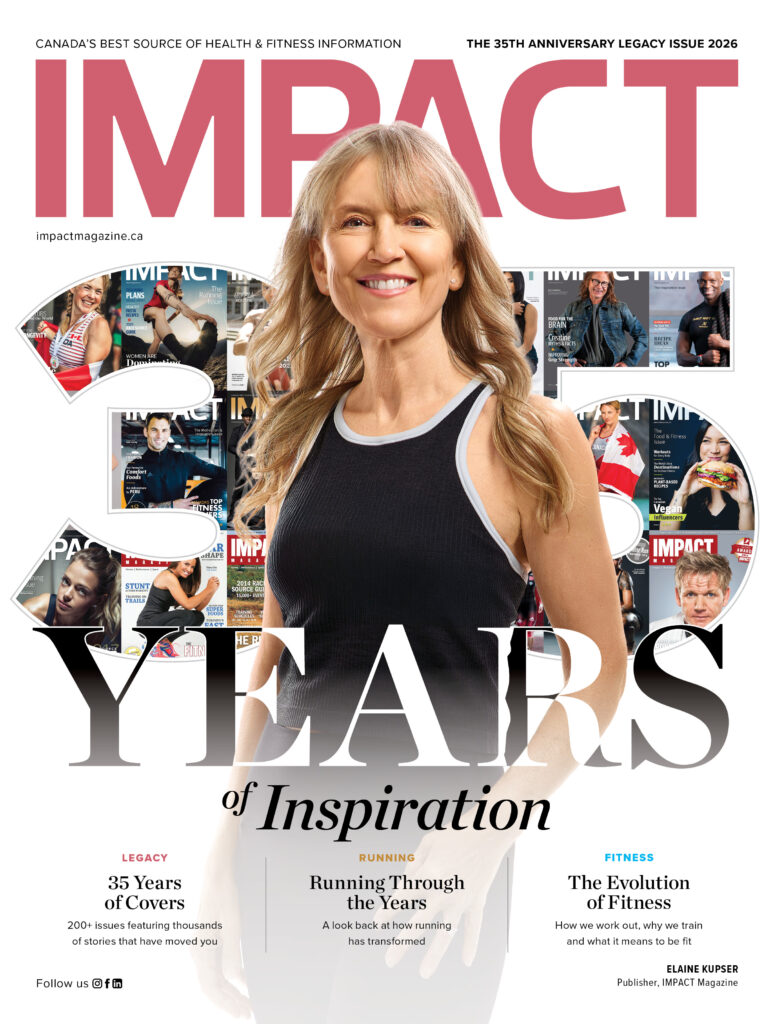
Celebrating 35 years of inspiring Canadians to live healthier, more active lives! This special Legacy Issue honours the people, stories, and milestones that have shaped IMPACT Magazine since 1991. Take a journey through our history, celebrate the achievements that have defined us, and discover the inspiration that continues to drive us forward.
35 Years of Inspiration. One Legacy.